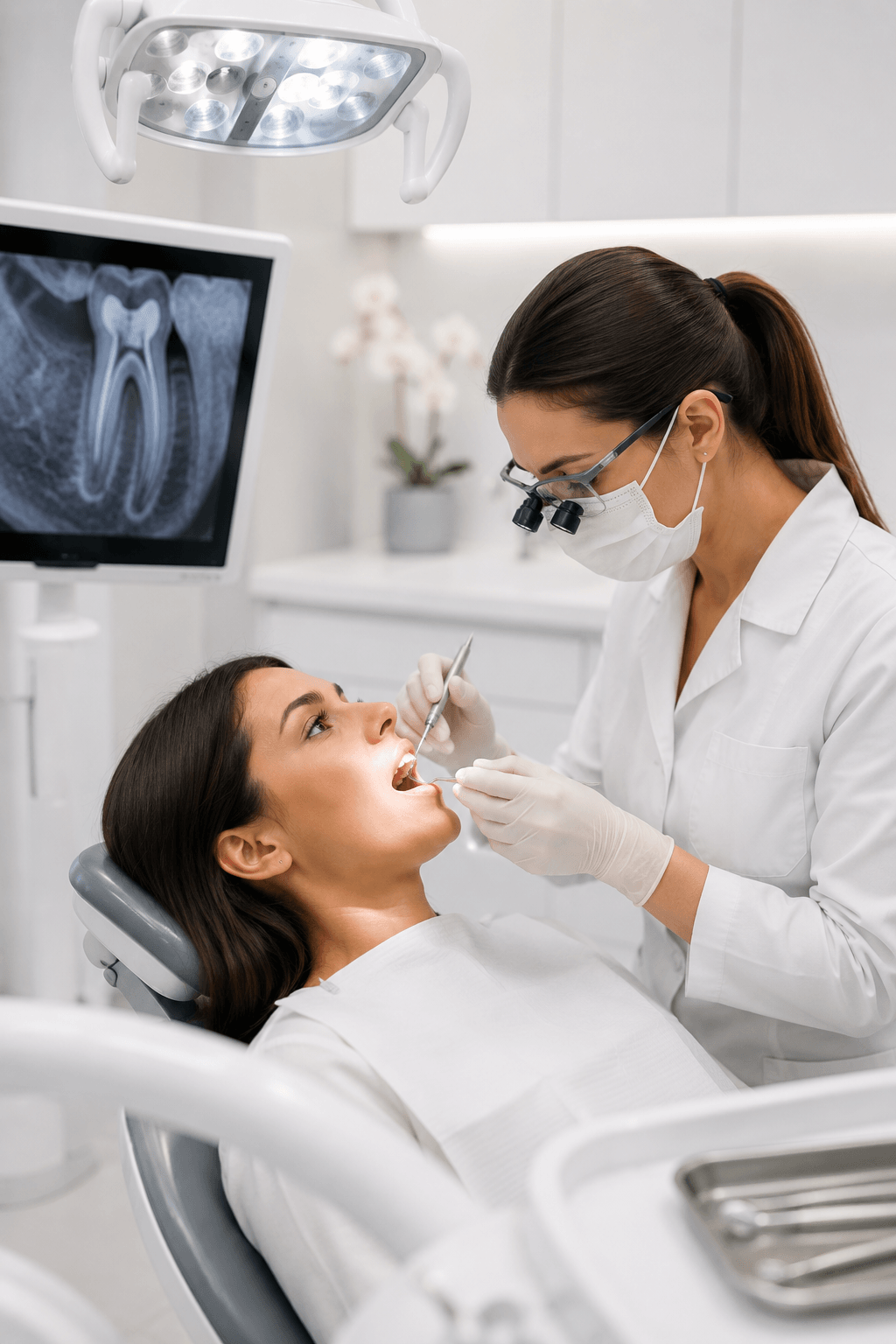
Therapeutic treatment focuses on pain relief, preserving the patient's natural teeth, and restoring their aesthetics and function. It includes prevention and painless treatment of tooth decay and its complications (root canal treatment). For all procedures that may cause pain or discomfort, we use local anesthesia.
Caries Treatment (Dental Fillings)
Dental caries (tooth decay) is the most common infectious disease. Early detection and treatment ensure the preservation of natural teeth and prevent more severe complications. Routine check-ups and X-rays enable early diagnosis and detection of hidden caries (for example, between teeth).
Treatment includes:
- Anesthesia and removal of decayed tissue
- Disinfection of tooth structures
- Restoration of the damaged part of the tooth with a filling
- We use high-grade modern composite (photopolymer) materials, ensuring aesthetics, strength, and durability of the restorations.
Endodontic (Root Canal) Treatment
If tooth decay is left untreated, the infection reaches the nerve of the tooth, leading to pulpitis or its complication – periodontitis. This requires endodontic treatment to control inflammation and pain, ultimately saving the tooth. Sometimes, an infection can also develop in teeth with previous root canal treatment, requiring retreatment.
Treatment includes:
- Anesthesia, opening, and securing endodontic access
- Cleaning, shaping, and disinfection of the root canals
- Precise determination of the number and length of root canals using an apex locator and X-rays
- In cases of periodontitis or granulomas, medication dressings may need to be changed several times until symptoms fully resolve
- Obturation (filling and sealing) of the root canals, followed by radiographic control
- Final restoration of the tooth and, if necessary, crown placement
Technological Advantage: Planmeca ProMax® 3D Classic
Seeing What Others Miss
Root canals are a complex, labyrinthine system. Standard 2D X-rays often fail to reveal hidden canals or complex anatomical curves.
- Detect hidden infections: 3D imaging reveals early-stage inflammation (granulomas).
- Map root canals: We see the exact number, length, and shape of the canals before starting treatment.
- Ensure predictable results: We minimize the risk of reinfection or incomplete canal filling.
- Painless Process: We use modern anesthetics that eliminate discomfort.
- Biocompatible Materials: We use latest-generation sealers for durable and safe root canal sealing.
When Is Endodontic Treatment Needed? (Symptoms)
- Severe, throbbing pain (especially at night)
- Sensitivity to touch or chewing
- Prolonged sensitivity to hot and cold
- Tooth discoloration or gum swelling
The tooth loses sensitivity to pain, but remains fully functional in your jaw. With time the devitalized teeth become more fragile and the risk of new cavities and fractures increases. It often leads to the need to put a crown on the tooth to protect it.
Without it it is possible to miss an accessory root canal or an existing inflamation. Control X-ray is recommended after the treatment to follow the result.
Depending on the complexity of the case, the procedure may be completed in one or several appointments.